
Since items in the 12% category account for only about 5% of total GST, the additional boost to consumption may not be significant, points out M Govinda Rao.
The CBIC has come out with guidelines on blocking of tax credit by GST field officers, saying that such blocking should be on the basis of 'material evidence' and not just out of 'suspicion'. The guidelines laid down five specific circumstances in which such credit could be blocked by a senior tax officer. These include availment of credit without any invoice or any valid document, or availing of credit by purchasers on invoices on which GST has not been paid by sellers.

'It must become faceless, just as the entire direct tax assessment system has already become fully online, without any human intervention in the normal course,' recommends A K Bhattacharya.

About 1.2 trillion tax evasion cases have been detected and as many as 59,000 entities identified for verification in order to ascertain whether they are fake.

Tax experts say one of the most dispute-prone proposals is making "fraudulent availing" of input tax credit (ITC), without an invoice or bill, a cognizable and non-bailable offence.

Average monthly GST collection rose from Rs 90,000 crore during the first year of its implementation -- 2017-2018 -- to Rs 1.68 trillion during 2023-2024, representing an 87 per cent rise.

Expanding investigation into allegedly wrongful claims of input tax credit by insurance companies, the tax authorities are probing a section of automobile dealers who have supposedly generated fake invoices without providing any service, which is a punishable offence under goods and services tax (GST) law. The authorities are learnt to have questioned the car dealers to explain the services they provided general insurance companies. The investigators suspect car dealers pitched for insurance schemes that give them commissions in excess of those insurance regulations permit.


Govt doesn't buy restaurants' input tax excuse and has swing into action and looking into profiteering complaints on social media against prominent restaurant and franchise chains.

'The challenge is particularly daunting in the case of services, where it is often hard to define the exact amount of the service rendered.'
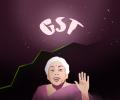
Lower rates effectively increase disposable income, strengthen purchasing capacity, and support broader consumption growth.

Across 10 prominent services, revenue to the government reduced by 20 per cent in the first year of GST compared to the last year of the service tax regime. This happened despite tax liability against these services growing by 50 per cent in one year.

Sources said that Langa and an unidentified employee of the Gujarat Maritime Board (GMB) have been booked on the charges of theft and under relevant sections of the Prevention of Corruption Act.

The Congress party has criticized Prime Minister Narendra Modi's handling of GST reforms, calling them inadequate and demanding an apology for the tax imposed on essential items. They argue that the reforms are merely a 'band-aid' solution and that the government should address the states' demand for extended compensation.
At least 120 insurance intermediaries and aggregators from across the country are under scrutiny, mainly from Mumbai, Gurugram and Bengaluru.

The move will help address apprehensions as well as potential disputes on various computational and transitional issues such as the loss of input credits and pricing that were bound to arise on account of the change.
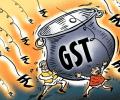
One of the grey areas is whether the anti-profiteering provisions can provide for a comparison of tax rates between the pre-GST and post-GST eras, says Niraj Bagri.

Armed with a potent spin attack, taking on South Africa seems like competing against a "subcontinent team", Ten Doeschate said, admitting that they need to get better at negotiating the challenge posed by tweakers.

Sources said GST exemption on such items would lead to blocked input tax credit, thereby increasing the cost of manufacturing and a higher price for consumers.

The matter has now been escalated and the ministry has written to Customs, Bureau of Indian Standards (BIS) and the Directorate of Revenue Intelligence (DRI) to investigate it thoroughly.

The increase in service tax from the 10 per cent to 12 per cent expected to impact the industry. This will negatively impact the industry. However, the reduction of cascading taxes by providing tax credits expected offset this. Also, the allowing 100 per cent deduction to the franchise model (operated by other) is positive to the sector.

The Cascading taxes has been reduced significantly by permitting utilization of input tax credits in a number of services such as catering, restaurants, hotel accommodation, pandal and shamiana and transport sectors.

An increase in the farmer income support scheme PM Kisan Nidhi, the introduction of a 'robot tax' to fund reskilling of people who lose their jobs to artificial intelligence (AI), and a reduced income-tax (I-T) to bring relief to the middle classes - these are some of the items in the Budget wish list submitted by Sangh Parivar affiliates to Finance Minister (FM) Nirmala Sitharaman. Representatives of the affiliates of the Rashtriya Swayamsevak Sangh (RSS), such as the farmer organisation Bharatiya Kisan Sangh (BKS); trade union Bharatiya Mazdoor Sangh (BMS); Laghu Udyog Bharati, which works for micro and small industries; and Swadeshi Jagran Manch (SJM), which works on economic and policy issues, met the FM and other officials over the last couple of weeks as part of the pre-Budget consultations.

State governments have requested the Centre for export incentives, lifting of import duty in the case of cotton for the textile sector and GST exemptions.

Maharashtra has topped the list of states with the most favourable ecosystem for the growth of Farmer Producer Organisations (FPOs), replacing Madhya Pradesh, which has slipped to second place, according to the latest Ease of Doing Business for FPOs (EoDBF) ranking.

The Indian government has expressed its disagreement with the IMF staff's 'baseline' assumption that the 50 per cent US tariffs on its goods exports 'would remain in place indefinitely', based on which the staff pegged the country's GDP growth at 6.6 per cent this year, and pared its 2026-27 projection by 20 basis points to 6.2 per cent.

Ask rediffGURU and PF expert Nitin Narkhede your mutual fund and personal finance-related questions.

Opposition-ruled states warn of steep annual losses; Centre assures higher consumption will offset revenue hit.
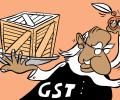
In a relief for foreign firms giving loans to Indian subsidiaries, tax authorities have said goods and services tax (GST) will not be imposed on them, subject to some caveats. Additional fees, commissions, or related payments - over and above the amount charged as interest - on these loans will attract GST at 18 per cent, the Central Board of Indirect Taxes and Customs (CBIC) has said.
Businesses with monthly turnover of over Rs 50 lakh will have to mandatorily pay at least 1 per cent of their GST liability in cash, the finance ministry said as it moved to curb evasion by fake invoicing. The Central Board of Indirect Taxes and Customs (CBIC) has introduced Rule 86B in Goods and Services Tax (GST) rules which restricts use of input tax credit (ITC) for discharging GST liability to 99 per cent. "... The registered person shall not use the amount available in electronic credit ledger to discharge his liability towards output tax in excess of 99 per cent of tax liability, in cases where the value of taxable supply ... in a month exceeds Rs 50 lakh," the CBIC said.

The Gujarat High Court dismissed a plea filed by journalist Mahesh Langa seeking the quashing of an FIR registered against him for allegedly stealing "highly sensitive and confidential documents" belonging to the Gujarat Maritime Board (GMB). The court found that prima facie, Langa's involvement in the crime was evident from the evidence collected during the investigation. The court further stated that the investigation is at a nascent stage and it would be inappropriate to exercise its inherent powers in favor of the petitioner at this stage.

Industry body Assocham has asked the government to retain both excise duty and service tax at existing rate of 10 per cent in the Budget for 2012-13.
Six years after the rollout of the biggest indirect tax reform in India, Goods and Services Tax (GST) revenue of Rs 1.5 lakh crore every month has become a new normal and tax officers are focusing on dealing with fraudsters who are adopting newer modus operandi to game the system, causing loss to the exchequer. To apprehend black sheep, who operate as syndicates and create fake entities on the basis of forged documents to claim input tax credit (ITC), tax officers have started using data analytics, artifical intelligence and machine learning aiming to curb evasion, which was over Rs 3 lakh crore since inception of GST. It was over Rs 1 lakh crore in 2022-23. Thinktank Global Trade Research Initiative (GTRI) said the most critical pending GST reform is upgradation of GST Network to prevent fake supplies and fraudulent claims of Input Tax Credit (ITC).

Experts said the builders will now factor in their losses arising from the removal of input tax credit when they pass on the benefits to end users while the latter may want the entire GST cut to be given to them.
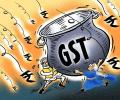
With Goods and Services Tax (GST) officers under pressure to exceed the Rs 1-trillion collection mark per month, industry has faced a barrage of recovery notices and summons issued over the last one month across sectors, according to company executives. Industry bodies have claimed harassment by field officers, blocking of input tax credit, cancellation of GST registration, threats of arrest and steep penalties, impacting their working capital and operations. Company executives pointed at an atmosphere of apprehension and fear due to such notices and summons.
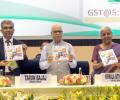
'We revolutionised the system in a manner so that the chances of leakage will be much lower than it was in the beginning.'

Adding petrol and diesel to GST was a challenging task due to their significant role as revenue generators for both the central and state governments.
The window for registration is open up to September 30

The GST Council had given the option to real estate companies to either opt for old rates of 12% (for residential) and 8 per cent (affordable housing) with ITC benefits or the new tax rates of 5% for residential units and 1% for affordable housing without the benefit of adjusting the credit on inputs used during construction.
